
What Is Almen Intensity, and Why Does It Matter in Peening?
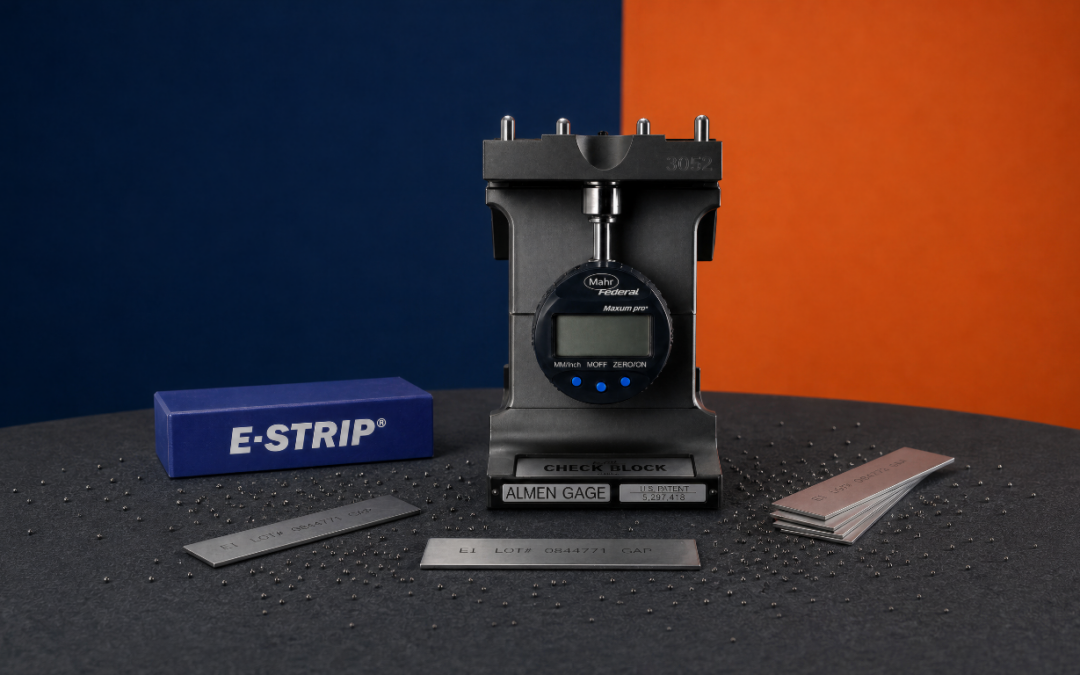
Almen intensity is a method for measuring the force of impact in a peening process. Developed by John O. Almen in 1942, the method has remained basically unchanged for the peening industry for over eight decades, used across flapper, needle, and conventional shot peening alike. At Shockform, we believe in clearly explaining this method, and in offering easy, accessible solutions to help operators find that intensity quickly.
How the Method Works 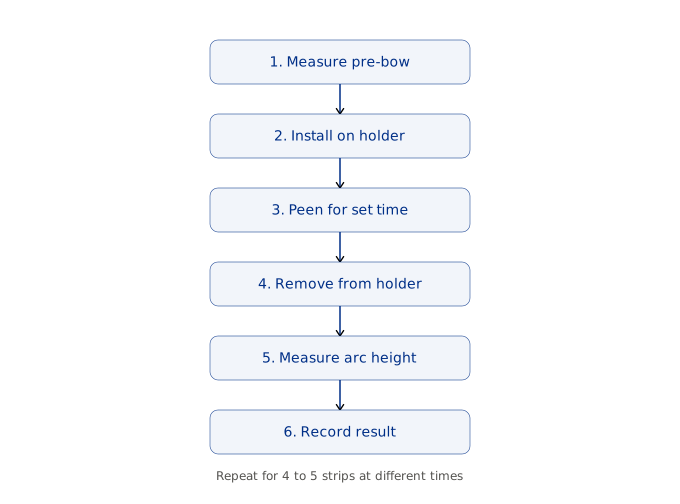
The principle is simple: a thin strip of hardened, rolled steel, called an Almen strip, is peened on one side only. The residual compressive stress created by the impact causes the strip to bend, or arc, toward the peened side. This deformation depends on several factors: the hardness of the peening media, its velocity, the angle of impact, and the flow rate of the media stream. It’s worth noting that arc height and Almen intensity are related but not the same thing, a distinction that is a common source of confusion. Arc height is the raw measurement, while intensity is the value operators derive from a full saturation curve using the 10% rule.
Almen strips measure 3.00 by 0.75 inches and come in three types, classified by thickness: A, N, and C. The higher the intensity range required, the thicker the strip needs to be. The A strip covers the most common intensity range across the industry, while N strips are used for lower-intensity applications and C strips for higher-intensity ones.
The Saturation Curve and the 10% Rule
In practice, measuring intensity requires more than a single reading. Operators peen a minimum of four Almen strips at different exposure times. All other process parameters stay constant. Operators plot the resulting arc heights against exposure time to generate a saturation curve. The 10% rule defines the intensity itself: it is the first point on the curve where doubling the exposure time increases the arc height by no more than 10%. This point is known as the saturation point. While the math can seem complex at first, it is the accepted way to ensure that peening intensity is being measured consistently, rather than simply chosen at random.
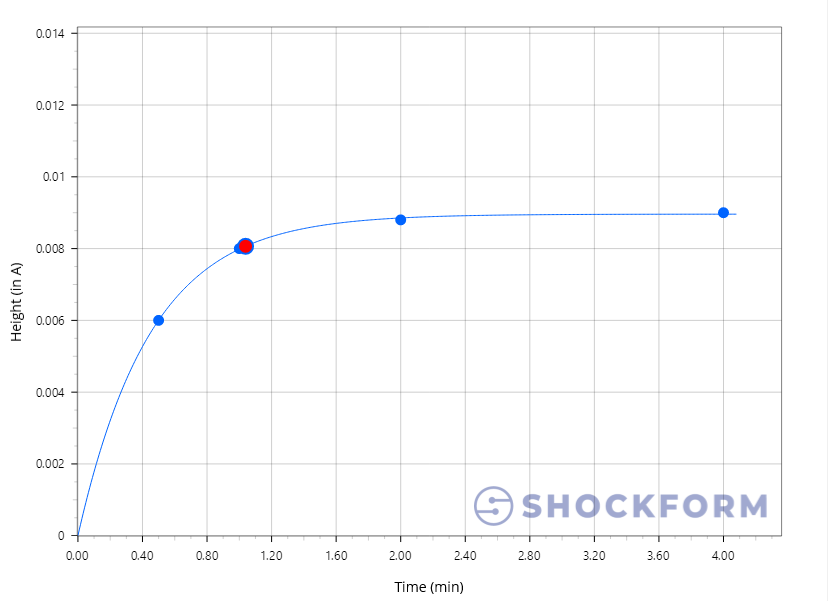
Shockform Saturation Curve Solver Software created this saturation curve.
Intensity Is Not the Same as Coverage
A common point of confusion is the difference between intensity and coverage. Intensity measures the force of impact; coverage measures how much of a part’s surface has been struck by the media. Older specifications sometimes used the time to reach intensity on an Almen strip as a proxy for coverage time, but this approach assumes the peened component is made of the same material as the Almen strip, which is rarely the case. Modern specifications instead define coverage through direct visual inspection of the peened surface, typically under 10x magnification.
Limits of the Method, and Modern Alternatives
Still, Almen intensity has known limitations. It indirectly measures impact force, inferring it from strip deformation rather than measuring it directly. Generating a saturation curve is also labour-intensive. In some operations, verifying intensity this way can account for up to 20-30% of total machine time. Each manual step also introduces room for operator variability and error.
In response, newer technologies aim to reduce these limitations depending on the peening process involved. Some systems use closed-loop process control, continuously monitoring and adjusting key parameters to produce highly repeatable results with less reliance on strip-by-strip verification. Others, like Shockform’s E-Strip® sensor, offer a faster, electronic alternative to traditional Almen strips, measuring impact force in real time. SAE J442 now includes the E-Strip®, the same standard that has long governed Almen strips and gages, placing this electronic measurement method on the same recognized footing as the industry’s historical reference.
Whichever method operators use to verify a peening process today, Almen intensity remains the reference against which they ultimately compare all these approaches.
FREQUENTLY ASKED QUESTIONS
Where can I get Almen strips, gages, or the E-Strip® sensor?
Shockform stocks Almen strips and gages in all standard types, and manufactures the E-Strip® sensor as a modern alternative for real-time intensity measurement.
Contact our team at sales@shockform.com to get a quote, ask for a demo, or get expert advice on which option fits your operation.