
Where FOD-Free Needle Peening Is Best
Flapper peening and needle peening both restore compressive residual stress after a repair, but for engines, the difference between them is that you must eliminate any risk of FOD (Foreign Object Debris). Because needle peening introduces no loose media, it suits repairs on partially or fully assembled engines best.
Why aero-engine repairs need portable alternatives
After blending the damaged area, you need to reintroduce peening to restore compressive residual stress and protect the component against future fatigue cracking. This is a mandatory requirement in all MRO repair programs. However, conventional shot peening isn’t always practical for these repairs: loose media could find themselves in assembled components such as landing gears, flap tracks, fuel access holes, engines and more. Alternative methods, like flapper peening and needle peening, therefore bring repeatable peening directly to the part, with minimum handling.
How flapper peening works
This process uses flexible flaps embedded with tungsten carbide beads. As the tool rotates the flap, the beads repeatedly strike the repair area, creating localized surface deformation and a layer of compressive residual stress.
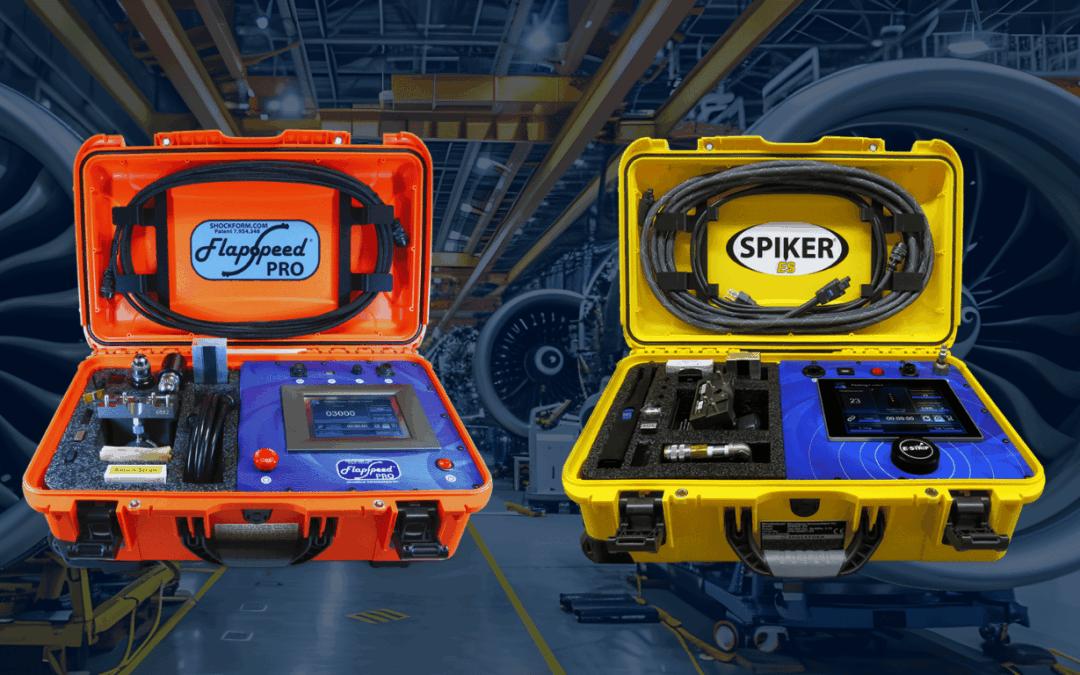
FlapSpeed® PRO brings controlled operating parameters to this portable process. It suits localized repairs on accessible areas of engine components, landing gear, and aircraft structures, wherever the flap has enough clearance to rotate and hit the surface of the part. It also covers intensities from 0.004A to 0.0165A inches (1,500 to 6,000 RPM).
How needle peening works
This method uses a closed-loop system comprising multiple tungsten carbide needles driven pneumatically to repeatedly impact the treated surface of the part to induce the same compressive layer as originally manufactured.
Shockform developed Spiker®-ES for aero-engine, turbine, and critical structure repairs, where access is tight and FOD is a concern. In addition, different head configurations reach features such as blade roots, internal bores, fillets, corners, and recessed areas that a rotating flap can struggle to treat.
Which process fits the repair?
| Consider | FlapSpeed® PRO (flapper peening) | Spiker®-ES (needle peening) |
| Process | Rotary flapper peening | Pneumatic needle peening |
| Media | Bonded tungsten carbide beads to a flap | Tungsten carbide needles |
| Engine state | Removed components, or controlled external access | Partially or fully assembled engine, critical components |
| Geometry | Accessible surface, clearance for flap rotation and hand | Radius and complex, tight, geometries |
| Head options | Straight or 90° grinder | Single-needle or 4-linear needles, straight or flex |
| Specifications met | AMS 2590, AMS 2430, AMS 2592, Nadcap AC7117/4 & Airbus SMR 51-29-11 | AMS 2545 & Nadcap AC7117/6 |
The question isn’t whether one method is better than the other: it’s which process can achieve the best results while respecting the component’s geometry, repair specifications, access limitations, and contamination restrictions. In short, with FlapSpeed® PRO and Spiker®-ES, Shockform gives aerospace OEM and MRO teams two complementary qualified tools to bring peening directly to the aero-engine repair.
Not sure which process your repair calls for, or need a quote? Reach out to our team at sales@shockform.com.
FREQUENTLY ASKED QUESTIONS
What’s the difference between flapper and needle peening?
Flapper peening uses tungsten carbide beads bonded to a rotating flap; needle peening uses hard needles driven pneumatically against the surface. Both restore compressive residual stress, but the needle-based process introduces no loose media, making it the choice for FOD-less repairs.
Can flapper peening be used on a fully assembled engine?
You can use it where the repair area is accessible and you can manage the risk from the flap’s bonded beads. However, for work where no loose media can be tolerated, needle peening is a better fit. In fatigue testing, needle peening has generally proven superior¹ to flapper peening.