
Peening: Reinforcing the Surface Against Fatigue
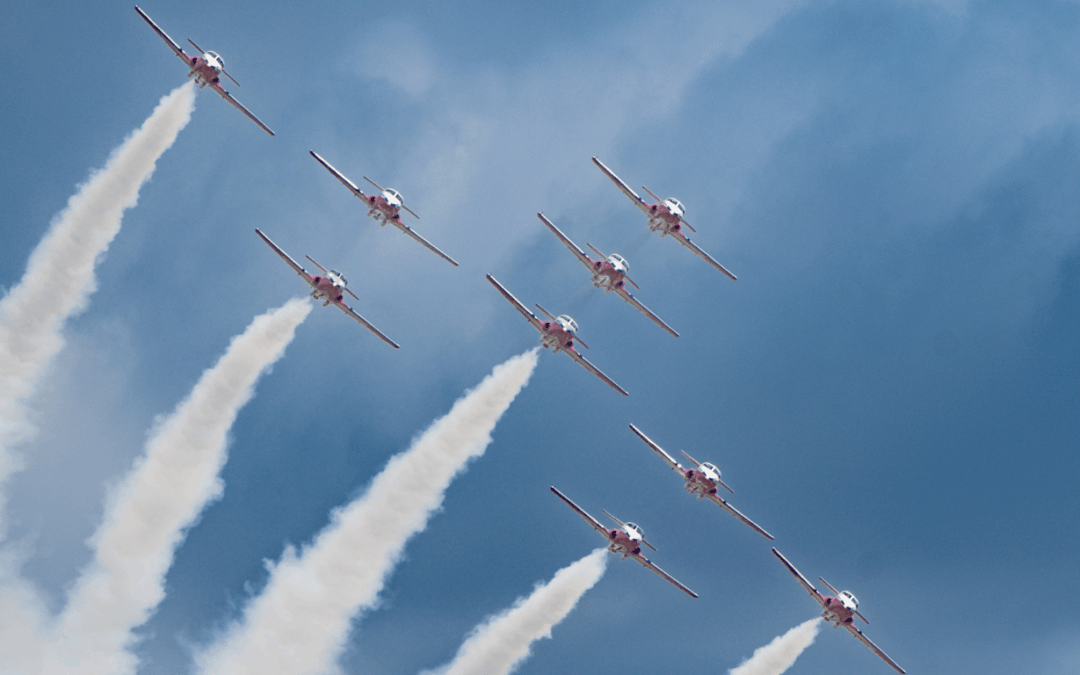
Airshows draw crowds eager to watch high-performance formation flying up close. Watching a tight formation pull through a high-G maneuver, it’s easy to focus on the spectacle, but every maneuver puts real, repeated stress on the airframe underneath. That’s structural fatigue: one of aerospace’s most persistent engineering challenges.
Why Cyclic Loading Is the Real Enemy
Every takeoff, high-G turn, and landing cycle stresses critical components: wing structures, landing gear, engine mounts. Over thousands of cycles, microscopic cracks can form at stress concentrations like a fastener hole or a machined edge. Left unaddressed, they propagate into costly repairs, or worse. As a result, the same logic drives one of aerospace’s fastest-growing concerns: operators keeping aging fleets in service well beyond their original design life, accumulating cycles year after year.
The Fix Starts at the Surface
The most effective way to delay or prevent fatigue cracking isn’t to make the metal thicker or heavier. It’s to change the state of the metal at the surface itself. This is where compressive residual stress comes in.
By mechanically working the surface of a component, you introduce a layer of compressive stress that actively resists the tensile stress responsible for crack initiation. Cracks simply have a much harder time starting (and propagating) through a surface engineered this way. This is why controlling that compressive layer, consistently and repeatably, is the actual engineering problem worth solving.
This is the exact principle behind Shockform’s core peening solutions:
- FlapSpeed® PRO: introduces a controlled compressive layer through rotary flapper action, right at the fastener holes and fillets on components like landing gear, where fatigue cracks typically start, without pulling the part off the aircraft.
- Spiker®-ES: through needle peening, brings that same compressive protection into tighter, more complex geometries, like engine components, exactly where fatigue cracking tends to originate but broader tools can’t physically follow.
- SmartPeen®: through controlled shot peening, applies a broader, uniform compressive treatment across larger surfaces, well suited to components like wing structure that absorb repeated, high-magnitude cyclic loads over their service life.
We engineer all three for the reality of MRO work: on-wing, on-engine, in hard-to-reach places, without the FOD risk or teardown time that large traditional peening equipment often requires elsewhere. Different components accumulate fatigue at different rates and in different geometries, which is exactly why Shockform builds three distinct solutions rather than one.
In short, that portability and mobility matter as much as the metallurgy. A solution that can’t be deployed where the aircraft actually sits isn’t a practical solution at all.
Where This Matters Most
The same principle supports Shockform’s applications across every sector we serve. Defence programs run repeated high-G maneuvers, Civil aviation & MRO fleets are aging past their original design life, and Energy & space components sit under constant cyclic load.
Whatever the sector, the underlying engineering problem is the same: surfaces under repeated cyclic loading need a compressive layer that outlasts the mission profile, not just the warranty period.
Want the technical detail: intensity, coverage, saturation curves, and how it’s measured? Our Peening FAQ covers the fundamentals in depth.
Talk to Us Before Fatigue Becomes a Finding
If your team is managing an aging fleet, or simply wants to understand how residual stress engineering fits into your maintenance program, we can help. In fact, our portable peening solutions solve this problem where it lives, in the hangar, on the wing, without pulling the component off the aircraft.